
Forum Replies Created
-
AuthorPosts
-
November 29, 2020 at 3:40 am in reply to: Question on Tapered Braced Style Guitars, Deep Body F Anyone? #5002
How deep is your OM grand? Is it stand depth or Martin J depth (dread depth)? I wonder if that’s a factor….
Oh FWIW, SCGC archtops are the ne plus ultra of modern archtop design. I played one at the Xmas party some years ago and just couldn’t stop smiling….so good. I also played an older one with a smaller body – 15”? – and it had huge punch. Just brilliant.
-
This reply was modified 5 years, 6 months ago by
Matt Hayden.
May I be next in line after Chris?
November 29, 2020 at 12:36 am in reply to: Question on Tapered Braced Style Guitars, Deep Body F Anyone? #4993The F body is already quite deep – it’s basically dread depth. To go too much deeper might enlarge the cavity to the point where it’d get a bit woofy and out of breath.
If you want bass, try a BBB – the SCGC Bob Brozman Baritone with (IIRC) a 28” scale. I think they’re tuned down to B, and they…rumble. They sound clear when strummed, fingerpick beautifully, and the basses will peel the paint off a wall or set off earthquake sensors within a reasonable space. If I had the $$, it’s one of the instruments I’d have; running ii-V-Is on it in the lower register is like a piano, and I’m not being entirely hyperbolic when I say that. I played some Leadbelly tunes on one and was surprised how much James P Johnson (stride piano) there was in the sound.
If you’re looking for that in an F, maybe a baritone F or FS with an extended scale length?
-
This reply was modified 5 years, 6 months ago by
We’re holding together. Beth’s back at the library, which is fortunately closed to the public, but still more people in a space than anyone’s comfortable with. My company, focused as it is on speech-driven development, is going gangbusters, and I’m working too many hours. Trying to keep a guitar in the home office and play during downtime; it’s not at all easy to find.
We’ll get by but it’ll be good to be past the winter spike in the virus, which is already underway in CA.
I’m down for attending on any of those dates.
Like a Zoom or in person?
I’m going to agree with Chris. While the Skye is amazing, an OM may be the balance of power and control your ear likes…that’s kind of what an OM is, really.
-
This reply was modified 5 years, 7 months ago by
Hank,
Here’s what I do with 12-strings:
- get the saddle to the height where I want the action, usually leaving a flat top. It’s buzzy but don’t worry – you’re not done yet.
- String up the guitar with that saddle to make marks where the strings pass over it.
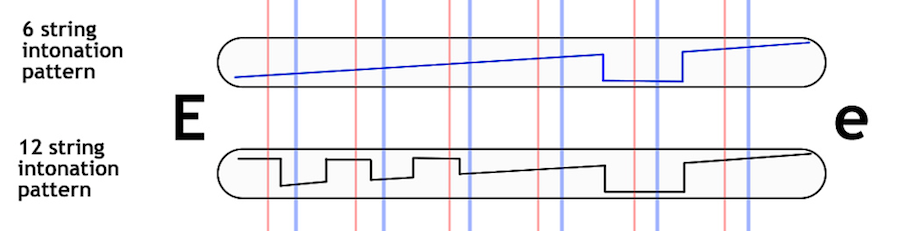
- Unstring & remove saddle, and then mark and file the compensation as shown above using a foam core nail file from CVS – they’re cheap, cut bone or tusq or ivory very well, and cost next to nothing. Don’t adjust the height, just the location of the break angle over the saddle.
- When you’re done, it’ll play wonderfully in tune.
This process works great for me. It takes some patience but it’s worth it. And your eyes aren’t so old that you can’t do it – I’m nearsighted as can be and I do it regularly.
-
This reply was modified 5 years, 7 months ago by
-
This reply was modified 5 years, 7 months ago by
He’s a loss.
I’ve decided to go ahead an install strap buttons. I figure that I can always fill it later if I need to…..
Hi Hank
The grooves in the saddle are likely worn in by the strings – strings seem to do that; they’re inherently abrasive. and the nut action could cause them to go sharp when capping.
Ultimately, though, it’s the adjustment to string length rather than string height that determines in-tune-ness. And that is a fussy thing. It’s possible to make 12-strings play more in tune by intonating the octave string to the front of the saddle and the normal string further back, but it takes time and effort. See the diagram below for a better idea. I’m doing this now on an old Ovation Glen Campbell and it’s making me glad I have both an abundance of patience and an abundance of tiny files. So far, I have the lowest 3 strings in reasonable tune, and will finish it up this weekend. The saddle looks like a piece of abstract art, but it works…..
If you’ve played many of the SCGC archtops – I’ve only played a few – they’re amazing. I think the one that mostly got my attention was very small – it was natural finish, spruce and (IIRC) maple, and relatively small (15” I think, or 16”? Richard Hoover, was that a thing?). It had the deco inlays. I played it while I was in CA years ago on travel from the east coast, well before moving here – one of the private equity financiers we were working with had it.
Anyhow, it was the single best fingerstyle archtop I’ve ever played. Acoustically it was just perfect – it was punchy and clear, big fat trebles for playing leads, stayed clear while playing hugely dissonant chords (think the opening chords of “Seven Steps to Heaven” with major seconds), and had a little flamenco-yes rasp in the sound. With a pick it was nice, but with fingernails, oh man. Chord-melody for days, and definitely more acoustic than electric. It was amazing.
That’ll happen someday, after my ship really comes in (go public, company!!! I want my stock to be worth something!!). Fortunately I have the OM and 00-29 to keep me busy; they’re not lacking.
It’s a sign. It means that there’s a recording project in the future with that bass’ name on it.
Signed, the guy who’s been trying to sell his Bozo dread and keeps not doing it (and having Bruce Sexauer refret it…).
The goal is, I think, to reduce the herd – or maybe the horde – to a couple of steel strings, a classical, two basses (upright and electric), and a couple of electrics that cover the range (SSS/HH/T/P90), gtr amp, bass amp/cab, and small PA.
It’s harder to get rid of stuff than it is to get it…..
How is the saddle on the Taylor compensated? If the octave strings are compensated to the same length as the regular gauge strings, they will always go sharp, irrespective of the brand. This is saddle (and possibly nut, depending on how far you’re willing to go) and string geometry, not the strings.
Google “12 string guitar saddle compensation” and look at the different solutions people have used to correct the string length (compensation) on 12 strings. It’s not common that the saddle on a 12-string is adequately wide (most are 3/32” or 2.3mm) to fully compensate the normal and octave strings, so some people widen the slot, while others add second saddles resting atop the bridge for the third through sixth courses to allow the octave strings to be compensated to play in tune.
(Signed, working on this on an older Ovation Glen Campbell 12-string. It’s maddening to try to intonate a 3/32” saddle on a 12-string.)
-
This reply was modified 5 years, 7 months ago by
-
This reply was modified 5 years, 6 months ago by
-
AuthorPosts
