
Forum Replies Created
-
AuthorPosts
-
Thank you all…
Please note:
SCGC Mid tension strings are not as heavy as most commercial medium Ga. sets, though they not as low tension as standard light gauge sets either.
OMG models are sent out with low tension SCGC strings because…the gauge of strings that we choose for a particular model is to please most peolple, most of the time. This is not a dictate or necessarily even a a recommendation. If you set and maintain your action (string height) to proper specifications than the use of strings like, or comparable to, SCGC Mid tension will be ok under normal heat and humidity conditions…please monitor your action, especially with seasonal change. Thank you!
Lower tension strings impart less energy than higher tensions, therefore generating less or more volume respectively. This is rarely as big of a consideration as the advantage to tension of the strings on the fretting hand and the shorter vs. longer distance between frets.
All the best,
Richard
Oh Matt! I love you, and your flattering question too.
Yes it is straightforward geometry…and I will be beholding to you if you would reverse engineer one and tell me what that actually is.
Here’s an insightful analogy that will expose our methodology: The professional engineer will carefully calculate all factors so that when building a bridge it will reach an accurate terminus on the other side, bear more than the maximum weight of its patrons and adequately insure their well being while in transit. The guitar maker, on the other hand, will make his first pass and….oops! a little to short. People are falling in the water. The next try and…oops! too long. People are exiting the bridge in the middle of a Walmart. Some subsequent attempt will be just right and others will wonder how they nailed it so!
Same with the guitar top. It is a complex bit of geometry, though it is still a defined shape that was arrived at through successive attempts to bring bridge height, neck angle and fret board trajectory into agreement. To achieve this shape; we use braces cut in a true radius with some that are only shaped to fit our intent. Finally the top is folded back away from the general plane of the top from about the center of the sound hole to create an extension of the plane of the fret board as it crosses the body. This happens as the top follows the shape that we created in the side assembly. Look up one of our guitars from 1978 and you will see where we started from; or come on over to the shop and I’ll show you! Until then…
All the best, Richard
Well….
I wish i had a great story for you. It’s good, but not great. The promotional tortoise and pearl like picks that we send out with our string subscriptions are made in bulk by our good friends the Jim Dunlop family a couple of hours north of our shop. They are .039″ thick and made from a proprietary polymer.
These are the ones I use and they suit me fine. We do however, have some hot rod versions made to our specs, though we haven’t gotten around to bragging about them because its a whole other job to manage sales of these one at a time.
If you’ll be so kind as to mail us through our website, to my attention, I’ll do my best to get some to you.
Best, Richard
Hi George,
I love this subject, though I can only address the tip of the iceberg in the space allowed here. I will stick to the tried and true laws of physics and spare you any personal opinions.
We just discussed how 45 style binding materials affect the sound of the guitar and the same principles apply to glues. If a material is resonant it will transfer vibration and if not it will resist vibration from passing through it.
In respect for the violin tradition we choose to isolate the top from the sides with a non-resonant material to direct string energy back into the top to pump more air (sound volume) out the sound hole. The alternative would be to connect the top to the sides with a resonant material to send the energy into the sides directing the volume to the player.
Here you can see how the difference in the glue’s hardness would allow the same manipulation. White poly vinyl resin never gets hard while hide glue dries like glass and yellow aliphatic resin sets in between the two in hardness. Each will transfer vibration at a different velocity and each will contribute to a different “tone” along the scale of bright/clear to warm/dark.
As an Example; Eric Skye’s jazz, classical finger-style is best represented from a guitar with a quick response and clear, articulate tone. We accomplish this, in part by attaching the top bracing and bridge with glass-like hot hide glue. We amplify that clarity by using stiff, bright Adirondack Spruce for the top bracing. Conversely; we use softer glue for the top to side adhesion to keep vibration within the top instead of allowing this energy (sound volume) to transfer into the sides.
Like many of our techniques for controlling the various parts of the guitar’s sound we will use several subtle manipulations that when combined produce the desired results. This is why we only offer hot hide glue when combined with Adirondack bracing and a brighter toned wood for the top. This ensures that we get a genuine difference in tone in which the use of hide glue plays a valuable part.
All the best, Richard
That’s a fun question!
Let’s start with how the binding affects the sound in general. The violin uses the little black/white/black fiber purfle to isolate the top from the body of the instrument. With out this the string’s energy would transfer from the top into the sides and back of the violin directing sound to the player at the expense of the audience. The same happens in the guitar. If the bindings don’t isolate the top from the body it will suffer in its ability to project the sound outward.
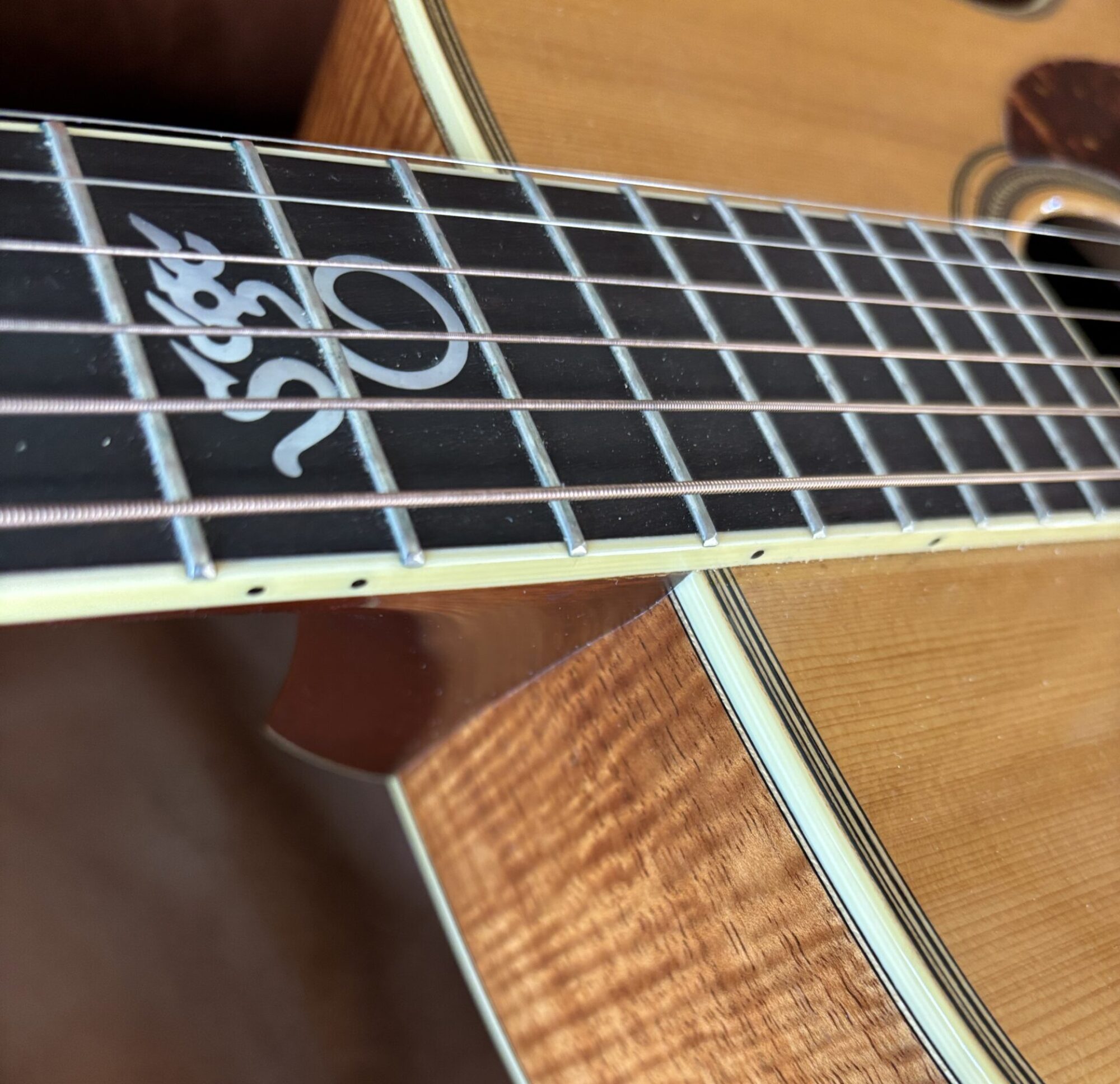
Your 45 style biding does an excellent job of isolation with two violin purfles book-ending abalone strips all working together by limiting the transfer of vibration away from your audience. Real wood or cellulose based bindings like Ivoroid add to the advantage. Contrast this with the laminated plastic binding found in production instruments. These will transfer rather than block vibration resulting in a guitar that seems louder to the player than to the audience. So your observation is correct 45 style binding allows better projection than plastic laminate bindings, which SCGC doesn’t use.
All the best, Richard
We list the gauge of strings that we choose for a particular model to please most peolple, most of the time. This is not a dictate or necessarily even a a recommendation.
The FS will be OK with mid tension SCGC strings if: The action is maintained at a reasonable height (no more that 3/32″ as measured from the bottom of the low E string to the top of the 12th fret). The neck should be adjusted to a proper relief for your playing style. There is a thorough description of this under ‘Care and feeding” at http://www.santacruzguitar.com Do note that when changing tensions on your guitar you may need to adjust neck and action to maintain the same settings that you had become accustomed to.
All the best,
Richard
Richard say’s “that was a great service, though difficult to keep current and verify the ever moving dealer inventories. Thanks to Carolyn for the valiant efforts to keep it relevant”
Carolyn say’s “www.reverb.com now does this for us. Whether considered good or bad most dealers, with few exceptions, list their complete inventories on this site”. You are always welcome to email us for missing or hard to find guitars: scgc@santacruzguitar.com Thank you!
Dear Zorro,
That button is secured by a wood screw that is tightened only enough to hold it in place. Any movement in the wood from temp or humidity and any compression of the felt washer that fits between the base of the button and the heel surface will allow the button to be turned. The remedy is an ever so slight clockwise turn to the button’s hold down screw. This will prevent it from turning, rattling or further disrupting you peace of mind.
Hi from all the crew!
Richard
-
AuthorPosts
